

Written by the ProTechMagazine Editorial Team | Reviewed by Jagdish Bhatt, Digital Marketing Expert, protechmagazine.com | Last updated: August 2026
Quick Answer:
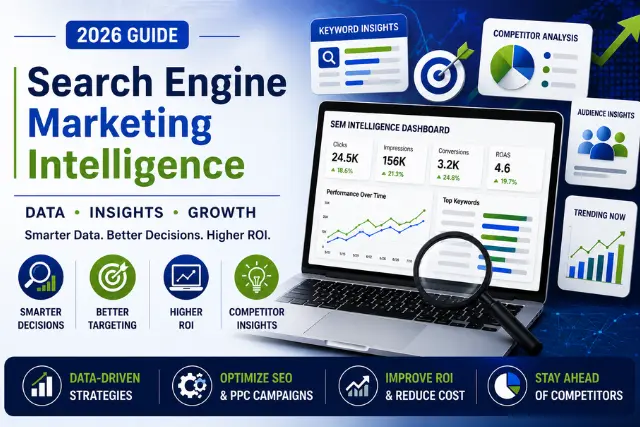
Search engine marketing intelligence uses the best in audience, competitor, and performance insights to make PPC and SEO decisions-rather than just winging it. Think keyword intelligence, competitor ad copy analysis, and search trend insights reveal what terms you’re paying for (but shouldn’t be) or that you’re neglecting. For 2026, the rise of AI Overviews and AI Mode has even reshaped the look of search results and turned intelligence into something essential, not an optional add-on.
Anyone running search engine marketing campaigns right now has felt it: costs keep climbing, and the keywords that used to convert reliably don’t stretch as far as they did two years ago. Part of that is simple competition — more advertisers chasing the same terms. But a bigger part of it is structural. Search results themselves have changed shape, with AI-generated summaries answering questions before anyone reaches a paid or organic listing, and guessing which keywords matter is no longer a viable strategy when the page itself looks different query to query.
This is exactly the gap search engine marketing intelligence closes. Instead of setting a budget and hoping the algorithm figures it out, it gives you the actual data — what competitors are bidding on, what search intent looks like behind a keyword, and where your Quality Score is quietly costing you money. If you’re new to digital marketing, it’s also worth understanding what a digital marketing account manager does, since this role often oversees SEO and SEM strategy together.
What is Search Engine Marketing Intelligence?
Search engine marketing intelligence is the systematic collection and analysis of data about keywords, competitors, audiences, and performance, used to make smarter paid and organic search decisions. If you’re asking what is search engine marketing in the first place — it’s the practice of promoting a website through paid placements on search engines, most commonly via Google Ads. Traditional SEM is running the campaign — choosing keywords, writing ads, setting bids. SEM intelligence is the layer underneath that tells you which keywords are actually worth choosing, which ad angles your competitors have already tested for you, and where the real opportunities are hiding.
The word “intelligence” here isn’t marketing fluff — it specifically means using competitive and audience data rather than internal assumptions. Instead of simply running Google Ads on keywords that sound relevant, SEM intelligence identifies which keywords competitors are actually bidding on, which of their ads are generating clicks, and where gaps exist that nobody’s bidding on yet.
Why Search Engine Marketing Intelligence Matters in 2026?
AI-Powered Search Has Changed the Page Itself
Google’s AI Overviews and AI Mode are no longer edge cases — they’re appearing across a growing share of search results, including mixed-intent and mid-funnel queries. Research from Pew has found AI-enhanced results pages cutting click-through rates by close to half, and Google has been steadily increasing how often ads appear within AI Overviews, with growth exceeding 50% in recent quarters. Bing’s Copilot and ChatGPT have also changed how people discover information online. If you’re interested in how AI is transforming decision-making beyond search, read our guide on artificial intelligence and problem solving.
What this means practically: search engine visibility now depends less on holding a top-10 ranking and more on whether your content or ads get selected as a trustworthy source within an AI-generated answer. Semrush’s own research on AI Mode found that roughly half of the domains cited inside AI responses don’t even appear in the traditional top 10 — a genuinely different game than five years ago.
Rising CPCs Are Punishing Guesswork
As more advertisers compete for shrinking pools of clickable, high-intent traffic, cost-per-click on competitive terms keeps climbing. Budget optimization stops being a quarterly exercise and becomes a weekly one — every wasted click on a poorly matched keyword is a click that a competitor’s better-targeted campaign didn’t have to pay for. This is exactly where combining SEO SEM data matters: paid intelligence shows you what’s working right now, while organic search engine ranking data shows what’s sustainable long-term.
Increased Competition Demands Sharper Targeting
More businesses are running paid search than ever, and broad-match, spray-and-pray campaigns simply can’t compete against advertisers segmenting by intent and refining continuously. Intent-first optimization — separating informational, commercial, and transactional queries into distinct campaign structures — has gone from a best practice to a baseline requirement.
How Search Engine Marketing Intelligence Works
- Collect keyword data – search volume, CPC, difficulty, and intent signals across your category.
- Analyze competitors – their keyword targets, ad copy, landing pages, and estimated spend.
- Study audience intent – what problem the searcher is actually trying to solve at each stage.
- Identify search trends – seasonal spikes, emerging terms, and shifts in how people phrase queries.
- Optimize campaigns – adjust bids, ad copy, and targeting based on what the data actually shows.
- Measure conversions – track what happens after the click, not just the click itself.
- Refine continuously – treat this as a loop, not a one-time setup.
Think of this as a cycle rather than a checklist — each pass through these seven steps should inform the next one, especially as AI-driven search features continue to shift month to month.
Core Components of Search Engine Marketing Intelligence
Keyword Intelligence
This covers the fundamentals: search volume, keyword difficulty, CPC benchmarks, the underlying search intent behind a term, and seasonal fluctuation. A keyword with high volume but poor intent match is often a worse bet than a lower-volume term with obvious buying signal.
Competitor Intelligence
This means tracking which keywords competitors bid on, what their ad copy says, which landing pages they send traffic to, roughly how much they’re spending, and — most usefully — where the gaps are that nobody’s targeting yet.
Audience Intelligence
Demographics, interests, device usage, geographic performance differences, and purchase intent signals all shape which segments are worth bidding more aggressively for and which aren’t converting regardless of position.
Performance Intelligence
The metrics that tell you whether any of this is actually working. This is where search engine marketing analysis earns its keep — turning raw numbers from the search engine results page and your ad dashboard into decisions:
| Metric | What It Tells You |
| CTR (Click-Through Rate) | Whether your ad copy and targeting are relevant enough to earn a click |
| CPC (Cost Per Click) | What you’re actually paying per visitor, and how competitive the term is |
| CPA (Cost Per Acquisition) | What each conversion actually costs, factoring in the full funnel |
| Conversion Rate | Whether the traffic you’re winning actually takes the action you want |
| ROAS (Return on Ad Spend) | Revenue generated per rupee or dollar spent on ads |
| Quality Score | Google’s own assessment of ad relevance, which directly affects your CPC |
These metrics should be reviewed together rather than in isolation. Google’s official Google Ads Help Center explains how metrics such as Quality Score, CPC, and conversion tracking influence campaign performance.
Trend Intelligence
Seasonal demand shifts, emerging keyword phrasing, changes driven by AI search adoption, and broader consumer behavior changes all belong here — this is the component most likely to get skipped, and the one that ages a strategy fastest when ignored.
Benefits of Search Engine Marketing Intelligence
Better ROI – spend concentrates on terms and audiences that actually convert.
Lower CPC – stronger Quality Scores and tighter relevance reduce what you pay per click.
Higher conversions – targeting intent rather than volume alone improves match quality.
Improved Quality Score – a direct result of better keyword-to-ad-to-landing-page alignment.
Smarter keyword selection – fewer wasted bids on terms that sound relevant but aren’t.
Faster campaign optimization – data-backed decisions cut the trial-and-error cycle shorter.
Better budget allocation – spend shifts toward what’s proven, not what’s assumed.
Improved SEO strategy – paid search data reveals intent and phrasing that strengthens organic content too.
SEO vs. SEM Intelligence
| SEO Intelligence | SEM Intelligence | |
| Data Sources | Organic rankings, backlinks, on-page signals, Search Console | Ad auctions, bid data, CPC benchmarks, ad copy performance |
| Primary Goal | Sustainable organic visibility and authority | Immediate, measurable paid traffic and conversions |
| Key Metrics | Rankings, organic traffic, backlinks, domain authority | CTR, CPC, CPA, ROAS, Quality Score |
| Timeframe | Long-term, often months to show results | Immediate to short-term feedback loop |
| Best Use Case | Building durable, compounding visibility | Testing intent, messaging, and demand quickly |
The two feed each other more than most teams realize — paid search intelligence often surfaces exactly which keyword phrasing and intent clusters are worth building organic content around, while organic performance data helps refine which paid terms are worth the premium CPC.
Best Search Engine Marketing Intelligence Tools
| Tool | Best For | Free/Paid | Main Strength | Limitation |
| Google Ads | Direct campaign data and Auction Insights | Free to use, pay for ad spend | First-party performance and competitor visibility in your own auctions | Limited visibility beyond your own campaigns |
| Google Analytics 4 | On-site behavior and conversion paths | Free (paid tier available) | Deep funnel and attribution data | Steeper learning curve than earlier versions |
| Google Search Console | Organic query and indexing data | Free | Direct data from Google on how your site is found | Doesn’t show AI Overview or AI Mode traffic yet |
| Semrush | All-in-one SEO and SEM research | Paid | Competitor keyword gaps, ad copy history, spend estimates, AI visibility tracking | Higher price point for smaller teams |
| Ahrefs | Keyword and backlink research | Paid | Strong keyword volume, ranking, and intent data | Less focused on paid ad intelligence specifically |
| SpyFu | Competitor PPC history | Paid (budget-friendly) | Historical ad copy and competitor keyword tracking | Smaller overall data set than Semrush or Ahrefs |
| Similarweb | Traffic and market share estimation | Freemium | Cross-site traffic comparison and channel breakdown | Estimates rather than exact figures |
| Microsoft Clarity | On-site user behavior (heatmaps, recordings) | Free | Visual insight into how visitors actually interact with landing pages | Behavior data only, no keyword or ad intelligence |
| Google Trends | Search interest over time | Free | Spotting seasonal and emerging trends early | Relative data only, no exact volume figures |
Choosing the right tool depends on your business size, budget, and SEO goals. If you’re also evaluating professional SEO partners, see our review of the best SEO agency Growmatic.
How to Use SEM Intelligence to Improve Google Ads?
- Find profitable keywords: Prioritize terms with strong intent signals over pure volume — a lower-search-volume term with clear buying intent often outperforms a broad, high-volume one.
- Build a negative keyword list: Exclude irrelevant terms early — words like “free,” “DIY,” or “cheap” often signal a mismatch with what you’re selling.
- Run competitor analysis: Search your target keywords, note which competitors show up consistently, and study their ad angles and landing pages.
- Adjust bids based on performance data: Shift budget toward the segments and terms with proven ROAS rather than spreading evenly.
- Test ad variations: Run structured A/B tests on headlines and offers rather than changing everything at once.
- Optimize landing pages: Make sure the page delivers on exactly what the ad promised — mismatches quietly kill Quality Score and conversion rate alike, and directly affect your search engine placement within paid results.
- Set up conversion tracking properly: None of the above matters if you can’t see which changes actually moved the needle.
Search Engine Marketing Strategies, Solutions & Services: Choosing Your Approach
Not every business needs the same setup. Broadly, search engine marketing strategies fall into three tiers, and knowing which one fits helps you decide where to invest first:
- In-house SEM analytics: Using tools like Google Ads and GA4 directly, suited to teams with the time to run their own sem analytics and campaign management week to week.
- Point tools for specific gaps: Layering in Semrush, Ahrefs, or SpyFu for competitor and keyword intelligence without a full agency engagement — a common middle ground for growing businesses.
- Full search engine marketing services: Outsourcing strategy, execution, and reporting to a specialized SEM marketing agency, typically the right call once campaign complexity or ad spend outgrows what an internal team can manage well.
The right search engine marketing solutions for a small local business look very different from what a B2B search engine marketing program needs — B2B campaigns typically deal with longer sales cycles, lower search volume per keyword, and a much heavier reliance on intent-matching and lead-quality tracking over raw SEM traffic numbers. Whichever tier you’re in, the same underlying intelligence — keyword, competitor, audience, and performance data — is what actually separates results from wasted spend.
Regardless of which approach you choose, long-term success depends on combining search intelligence with a well-planned content strategy. Learn whether digital marketing agencies create content and how content supports both SEO and paid search campaigns.
Common Mistakes Businesses Make
- Only tracking clicks instead of what happens after the click.
- Ignoring search intent in favor of chasing volume alone.
- Copying competitor ads directly rather than using their approach as a starting signal.
- Not monitoring Quality Score until CPC has already crept up noticeably.
- Poor landing pages that don’t match what the ad copy promised.
- Using broad match excessively without the negative keyword hygiene to control it.
- Ignoring first-party data in favor of platform-reported metrics alone.
- No conversion tracking, which makes every other optimization a guess.
Many of these mistakes can be avoided by following Google’s official best practices for campaign measurement and conversion tracking. The Google Analytics Help Center provides detailed guidance on setting up accurate reporting and attribution.
Real-World Example: An eCommerce Running Shoe Retailer
The challenge: A mid-sized online shoe store running store was on a constant spending streak on Google Ads. But with every quarter passing by the CPA continued to hike and the conversion rate on Google remained stubbornly between 1.8% to 2.1%.
Data analyzed: A competitor keyword gap analysis revealed rivals were bidding heavily on long-tail, intent-rich terms like “best running shoes for flat feet” and “trail running shoes for wide feet” — queries the store wasn’t targeting at all, having focused mainly on broad terms like “running shoes.”
Changes implemented: The store restructured campaigns around intent clusters, built a dedicated landing page for flat-feet and wide-feet searches, added a negative keyword list to cut spend on browsing-stage terms like “running shoes history,” and shifted 30% of budget toward the newly identified long-tail cluster.
Results: Over the following quarter, CPA dropped by roughly 22%, conversion rate rose to 2.9%, and overall ROAS improved even though total ad spend stayed flat — the budget simply moved toward where genuine intent already existed.
Best Practices for 2026
- Optimize for user intent rather than keywords alone — the phrasing matters less than the underlying need.
- Use first-party analytics to understand actual customer behavior, not just platform-reported summaries.
- Monitor AI-driven search changes alongside traditional rankings, since visibility now depends on both.
- Combine SEO and PPC insights so each channel informs the other rather than operating in silos.
- Refresh keyword research regularly — search phrasing shifts faster than it used to, partly driven by conversational search habits.
- Test landing pages continuously rather than treating them as a one-time build.
- Prioritize conversion quality over traffic volume, especially as AI Overviews reduce total click volume industry-wide.
Expert Tip
Don’t rely solely on keyword rankings or click-through rates. Evaluate every campaign based on business outcomes such as qualified leads, conversion rate, CPA, and return on ad spend. In today’s AI-driven search landscape, user intent and content quality are just as important as bidding strategies.
Conclusion
Data-driven marketing consistently outperforms guesswork, and that gap is only widening as search itself becomes more automated and AI-mediated. Search engine marketing intelligence gives you the actual evidence of what competitors are doing, what your audience actually wants, and where your budget is quietly underperforming instead of a best guess dressed up as strategy. Whether you’re managing a six-figure PPC budget or running your first campaign, building a long-term SEO strategy is equally important. You can also explore insights from James Dooley, one of the best international SEO speakers, to stay updated with modern search trends and strategies.
Key Takeaways
- Search engine marketing intelligence combines SEO and PPC insights.
- AI-powered search has changed how users discover content.
- Keyword intent matters more than search volume alone.
- Competitor analysis helps uncover untapped opportunities.
- Performance metrics like CPA, ROAS, and Quality Score should guide optimization.
- Continuous testing delivers better long-term campaign performance.
Frequently Asked Questions (FAQs)
What is search engine marketing intelligence?
It’s the practice of using keyword, competitor, audience, and performance data to guide search advertising and SEO decisions, rather than relying on assumptions about what should work.
How is SEM intelligence different from SEO?
SEO focuses on earning organic visibility over time through content and technical optimization. SEM intelligence specifically informs paid search decisions, though the two increasingly share data and insights.
Which tools are best for SEM intelligence?
Semrush and Ahrefs offer the most comprehensive research capabilities, SpyFu is a strong budget option for competitor ad history, and Google’s own tools (Ads, Analytics, Search Console) provide essential first-party data at no extra cost.
Is SEM intelligence only for large businesses?
No. Smaller businesses arguably benefit more, since wasted spend hurts a limited budget disproportionately — even free tools like Google Trends and Search Console provide a meaningful starting point.
Can SEM intelligence reduce Google Ads costs?
Yes, primarily by improving Quality Score through better keyword-ad-landing page alignment, and by reallocating budget away from underperforming terms toward proven ones.
How often should SEM data be analyzed?
Core performance metrics are worth reviewing weekly, while deeper competitor and trend analysis is typically useful on a monthly cycle, with more frequent checks during high-competition seasonal periods.
What metrics matter most?
Conversion rate, CPA, and ROAS matter more than CTR or impressions alone, since they reflect actual business outcomes rather than surface-level engagement.
Is AI changing search engine marketing intelligence?
Significantly. AI Overviews and AI Mode have reduced traditional click volume and introduced new ad placements within AI-generated summaries, meaning intelligence now needs to track visibility inside AI answers, not just traditional rankings and ad positions.
Do I need both SEO and SEM intelligence, or just one?
Both work better together. Paid search data reveals real-time intent and phrasing quickly, while organic data shows what sustains visibility over the long run — using only one leaves clear gaps in strategy.
About ProTech Magazine: ProTech Magazine covers digital marketing, SEO, and emerging technology trends for marketers and business owners navigating an increasingly AI-driven search landscape. This article reflects publicly available industry research and platform documentation as of August 2026, and is updated periodically as search engine features evolve. Tool pricing, features, and platform capabilities are subject to change — always verify current details directly with each provider.