

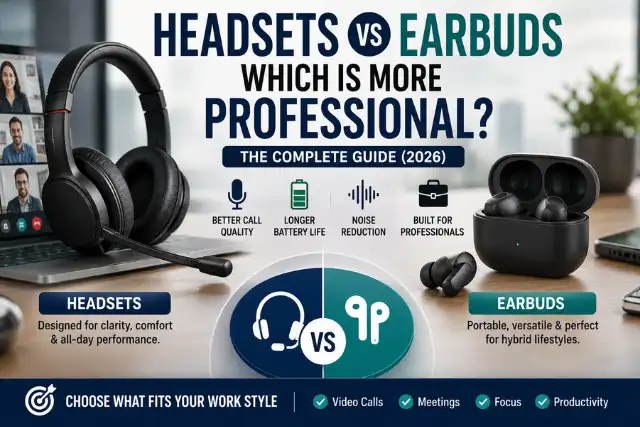
Written by the ProTechMagazine Content Team | Reviewed by Deepu Thakur, Technology Enthusiast, protechmagazine.com | Last updated: July 2026
Quick Answer: Headsets vs Earbuds
Headsets are generally more professional than earbuds for video calls, client meetings, and office work. They offer dedicated boom microphones that position closer to your mouth, delivering clearer voice pickup, better noise rejection, and significantly longer battery life (up to 30–40 hours vs. 4–8 hours for earbuds). However, premium earbuds like AirPods Pro 3 or Bose QuietComfort Ultra can perform comparably in quieter environments and offer far better portability. The right choice depends on your work environment and how critical audio quality is to your day.
Let’s be real — you’ve probably been on a Zoom call where someone sounds like they’re speaking from inside a tin can, and another where the person sounds like they’re broadcasting from a studio. The difference almost always comes down to one thing: their audio setup. So the question — are headsets or earbuds more professional? — isn’t just about appearances. It’s about how you sound to the person on the other end, and whether your setup holds up through a full day of back-to-back calls.
Short version: for most professional environments, especially video calls, dedicated headsets have the edge. But the full answer is more nuanced — because the right choice depends on your work style, environment, and how much you care about battery life vs. portability. If you’re also shopping for audio devices, our guide to the best wireless earbuds under $200 can help you compare some of the most popular options before making a decision.
Why Your Audio Choice Actually Matters More Than You Think
Here’s something most people underestimate: how you sound on a call affects how you’re perceived professionally — full stop. With over 36 million remote and hybrid workers relying on video conferencing in 2025, professionals need reliable audio to come across as competent and prepared. A muffled mic, a crackling connection, or background noise bleeding into a client call sends an unspoken message — that you’re not set up properly for serious work.
And this isn’t just about vanity. In a world where hybrid work is the norm, your audio gear has become as much a professional signal as a pressed shirt used to be in an office. The gear you wear on your ears — whether headsets or earbuds — either reinforces your credibility or quietly undermines it.
The core difference: Headsets are purpose-built for voice communication. Earbuds are built for music and casual calls, then adapted for work. That design origin affects everything — mic placement, noise handling, and battery life.
Headsets vs. Earbuds: The Real Differences That Affect Professionalism
| Factor | Headsets | Earbuds |
| Microphone Type | Boom mic — close to mouth, precise pickup | Array mic — farther from mouth, picks up more ambient noise |
| Voice Clarity on Calls | Richer, clearer, more “broadcast” quality | Audible, but thinner — especially on cheaper models |
| Background Noise Rejection | Industry-grade noise cancellation on dedicated mics | Improving rapidly; premium buds handle it well |
| Battery Life | 20–40 hours continuous use | 4–8 hours per charge (case needed for all-day) |
| Comfort for All-Day Wear | Over-ear cushions, even weight distribution | In-ear fit can cause fatigue over many hours |
| Portability | Bulkier, harder to carry on commutes | Pocket-sized, great for hybrid workers on the move |
| Connection Stability | DECT or USB dongle — rock-solid wireless | Bluetooth only — occasional drops in crowded RF environments |
| Visual Professionalism on Video | Visible on camera — not everyone’s preference | Discreet — barely visible during video calls |
| UC Platform Certification | Many certified for Teams, Zoom, Webex | Rarely certified for enterprise UC platforms |
| Price Range | ~ $50–$400 for quality work models | ~ $50–$300 for quality work models |
Microphone Quality — Where Headsets Win Big
This is the single biggest professional differentiator between headsets and earbuds. A dedicated headset features a boom microphone — that arm extending toward your mouth — which positions the mic 2–3 inches from your lips. The result is cleaner audio pickup, less room ambience, and dramatically better noise rejection.
Earbuds, on the other hand, rely on microphone arrays built into each bud — sitting several inches from your mouth in your ear canal. One of the core reasons earbuds come up short for professional use is they don’t have a microphone boom — which is fundamental to getting that “radio quality” voice pickup that makes professional headsets sound so much richer.
Most earbuds are designed for music or casual personal calls, not for business-grade unified communications platforms like Microsoft Teams or Zoom. Their microphones simply aren’t optimized for professional settings — risking muffled audio or dropped connections during high-stakes calls.
Real talk: ANC (Active Noise Cancellation) on your earbuds refers to what you hear — the noise cancellation on your speakers. It doesn’t directly improve what the other person hears on the call. That’s a microphone function — and headsets invest far more into this side of the equation.
Battery Life — A Bigger Deal Than Most People Realize
There’s a specific kind of professional anxiety that comes from watching your earbuds’ battery drop to 12% twenty minutes into a 90-minute client call. It’s a uniquely modern form of stress — and one that dedicated headsets largely eliminate.
Professional headsets offer up to 40 hours of talk time, making them ideal for all-day use in hybrid work settings. Compare that with typical earbuds which deliver 4–8 hours of listening time per charge — meaning most people are relying on the charging case mid-day.
Most professional wireless headsets are built to last through long workdays without interruption — with fast charging options that give you 8 hours of usage from just 15 minutes on the charger, eliminating battery anxiety during important meetings or client calls.
If your workday involves 4+ hours of calls, battery life alone is a compelling argument for a dedicated headset. Earbuds are great for a morning standup or a quick Zoom — less ideal for marathon call days.
Are Headsets or Earbuds More Professional for Video Calls?
On video calls specifically, there are two layers to “professionalism” — how you sound, and how you look. They pull in opposite directions when it comes to headsets vs. earbuds.
Headset — Sounds More Professional
Boom mic delivers richer voice quality. Dedicated noise cancellation isolates your voice. Stable DECT wireless means zero dropout risk. UC platform certifications for Teams/Zoom.
Earbuds — Look More Minimal on Camera
Discreet on camera — nearly invisible. Don’t make you look like an air traffic controller. Preferred in client-facing video scenarios by many professionals.
Earbuds — Best for Short Calls
Perfect for 30-60 minute video meetings. Portable enough to use on your commute or at a coffee shop. Premium models now deliver genuinely solid call quality.
Headset — Best for Call-Heavy Days
All-day battery life, consistent audio, and dedicated call controls. If you’re on calls for 6+ hours, there’s no contest. Headsets are built for this.
The nuanced answer: if you’re on video calls 1–2 times a day and care about looking minimal on camera, premium earbuds with solid microphone quality (like AirPods Pro 3 or Sony WF-1000XM4) are perfectly professional. If you’re on calls all day long in a noisy environment, a dedicated headset will make you sound more professional to every single person on the other end.
Which Should YOU Use?
The honest truth is there’s no universal winner. Here’s a plain-language guide based on your actual work situation:
| Your Situation | Better Choice | Why |
| 6+ hours of calls per day in an open office | Headset | All-day battery life, boom mic handles noise, UC certified |
| 2–3 Zoom calls per day, quiet home office | Either | Premium earbuds (AirPods Pro 3, Bose QC Ultra) handle this well |
| Hybrid worker — office 3 days, remote 2 days | Earbuds | Portability wins — take them everywhere, work in both environments |
| High-stakes client calls or sales demos | Headset | Mic boom quality reduces risk — you can’t afford a bad-sounding call |
| On-camera video calls where looks matter | Earbuds | Less visible on camera — cleaner, more polished visual appearance |
| Noisy office or open-plan workspace | Headset | Dedicated noise cancellation on the mic is superior in loud environments |
| Commuter taking calls on the move | Earbuds | Compact and portable — headsets are impractical on public transit |
| Gaming streamer or content creator with side business calls | Headset | Gaming headsets often have excellent boom mics — great dual-purpose value |
What Professional Headsets Have That Consumer Earbuds Don’t
There’s a distinction worth making here: “professional headset” doesn’t just mean any over-ear headphone with a mic. Professional headsets are specifically designed for unified communications (UC) platforms like Microsoft Teams or Zoom — with features like beamforming noise cancellation, stable DECT wireless connections, and UC platform certification that consumer earbuds simply don’t offer.
Some of the practical advantages that genuinely matter day-to-day:
Dedicated call controls – physical mute/unmute and volume buttons, right on the headset. No hunting for the mute button in your meeting app while someone’s talking to you.
DECT wireless technology – provides a longer, more stable wireless range than Bluetooth. You can walk around the office on a call without audio glitching.
Teams/Zoom certification – headsets certified for UC platforms integrate natively with your call app. Answer calls, mute, adjust volume — all from the headset controls.
All-day battery life – 20 to 40 hours of continuous use. You charge once a day or less. No case juggling, no mid-call panic.
Boom microphone positioning – the physical mic arm positions the microphone close to your mouth, picking up your voice cleanly and leaving ambient noise behind.
Worth knowing: Professional headsets distribute pressure more evenly across the head and ears, making them significantly more comfortable for long meetings and back-to-back calls — compared to earbuds that sit inside the ear canal and can cause fatigue after extended wear.
When Earbuds ARE Professional Enough — Don’t Sleep on Modern Premium Buds
Here’s the fair counterpoint: the gap between earbuds and headsets for professional use has narrowed significantly in the past two years. Modern premium earbuds have gotten genuinely good for call use. For official Bluetooth specifications and wireless audio standards, visit the Bluetooth SIG website.
Over-ear headphones tend to have longer battery life, but most true wireless earbuds now last upwards of 4.5 hours between charges — which is enough for all but the longest voice and video calls. And for ambient noise handling, some of today’s flagship earbuds are legitimately impressive.
The AirPods Pro 3 delivers exceptional call quality — even when strolling by a highway or passing a train, the person on the other end hears your voice clearly with background noise filtered out. The Bose QuietComfort Ultra earbuds similarly deliver near-headset-level call quality in quiet to moderate environments.
Thus, for hybrid workers, if you put a premium on the versatility, portability, and appearance on camera, you really can’t do better than shelling out $200-$300 for some high-end earbuds. Having said all that: If you have a loud working environment, or spend 6 or more hours per day on calls, you will undoubtedly hear- and the callers will hear – the benefit of a specialized headset.
Things to Consider Before Buying
- Call duration
- Office noise level
- Battery requirements
- Comfort for extended wear
- Compatibility with Teams or Zoom
- Budget
- Portability
The Bottom Line
So — are headsets or earbuds more professional? The straightforward answer is: for pure audio professionalism on calls, headsets win. Better microphone, better noise rejection, longer battery life, and purpose-built design for voice communication. If you’re on calls for hours daily, there is a real, audible difference — and the people on the other end notice it.
But “more professional” doesn’t mean earbuds are unprofessional. For a hybrid professional who wants one device that handles calls, commute, the gym, and everything in between, premium earbuds are a legitimately strong choice. The AirPods Pro 3, Bose QuietComfort Ultra, and Sony WF-1000XM4 have all closed the gap significantly on call quality. They just still can’t match a boom mic in a noisy environment.
Pick based on your actual work pattern: call-heavy day job in a busy environment → headset. Hybrid lifestyle with moderate calls → premium earbuds. You now know enough to make the right call — pun intended. If you’re building a productive remote workspace, understanding how technology affects your sleep health can also help improve focus and long-term work performance.
Frequently Asked Questions
Are headsets or earbuds more professional overall?
For most professional settings — especially high-call-volume work, open offices, and client-facing roles — headsets are more professional. They deliver better microphone quality via a boom mic, superior noise rejection, longer battery life (20–40 hours), and stable DECT wireless connections. That said, premium earbuds are completely professional for lower-volume call environments or hybrid workers who prioritize portability.
Are headsets or earbuds more professional for video calls specifically?
Headsets sound more professional on video calls — richer voice, better background noise suppression, dedicated call controls. Earbuds look more professional on camera because they’re nearly invisible. The decision comes down to priorities: if your audio quality matters most (client calls, interviews, presentations), go with a headset. If visual minimalism matters (broadcast, on-camera work), quality earbuds are the better choice.
What is the difference between a headset and headphones for work?
A headset is purpose-built for voice communication — it includes a dedicated boom microphone positioned near your mouth for clear voice pickup. Headphones are primarily designed for audio output (listening) and may include an incidental microphone. For professional work calls, a headset outperforms standard headphones because the mic is designed specifically for voice, not added as an afterthought.
Do headsets or earbuds have better battery life for work?
Dedicated headsets win significantly on battery life. Professional models like the Jabra Evolve2 or Yealink HA64 deliver 20–40 hours of continuous use per charge. Premium earbuds typically deliver 4–8 hours per charge (using the case for all-day use). For call-heavy workdays, battery life alone is a strong argument for a headset.
Are earbuds unprofessional in a work setting?
No — earbuds are not inherently unprofessional. Modern premium earbuds from Apple, Sony, and Bose offer call quality that’s completely adequate for most professional scenarios. The perception depends on your industry and role. In tech, media, and creative fields, earbuds are entirely accepted. In more traditional corporate or customer-service environments, a dedicated headset may still signal more “serious” intent.
What about on ear vs over ear headphones for work?
For work use, over-ear headphones generally provide better passive noise isolation and comfort during long sessions compared to on-ear models. Over-ear designs create a full seal around the ear, blocking more ambient noise and distributing weight more evenly. On-ear headphones are lighter and more compact but can cause pressure fatigue over hours of use. Neither replaces a dedicated headset with a boom mic if microphone quality is the priority.